guides
Waterproof vs Water-Resistant Fishing Backpacks
A water-resistant fishing backpack can resist some moisture without promising to keep its contents dry through prolonged rain or immersion. A waterproof claim should be read with its stated conditions, closure requirements and limits. The fabric alone cannot describe the whole bag: seams, zippers, openings and external pockets may behave differently. Choose protection for the exposure you expect and the consequences of a leak, then confirm how the particular pack must be closed and maintained to provide that protection.
As an Amazon Associate I earn from qualifying purchases. About affiliate links.
The three retained offers are exact Fishpond Thunderhead, Simms Dry Creek Rolltop and YETI Panga 28 records. They represent different closure and organization choices; no roll-top offer is presented as proof of an immersion rating.
 fishpond Thunderhead Waterproof Backpack – Fully Submersible Zipper, Accessory Attachments, 28L | Fishing Backpack - Eco YuccaCheck Amazon offer
  Simms DRY CREEK ROLLTOP BACKPACK ORANGECheck Amazon offer
 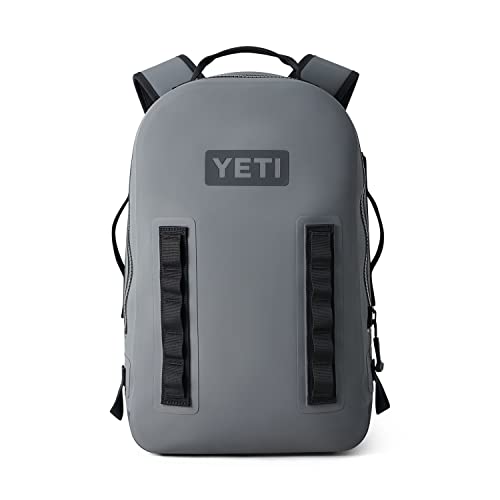 YETI Panga 28 Airtight Waterproof Submersible BackpackCheck Amazon offer
 Compare the approaches
| Decision | First option | Second option |
|---|---|---|
| Claim to look for | Water-resistant fabric, a coated base or a fitted rain cover for rain and splash management. | A complete-compartment waterproof or submersible claim with stated closure conditions; prefer a published test rating when the exact limit matters. |
| Likely weak point | Ordinary zippers, stitched seams, uncovered harness side and openings exposed when the cover is removed. | A dry zipper that is not fully seated, a roll top without enough clean material to close, or any damaged sealing surface. |
| Pocket rule | Treat each pocket as unprotected unless its own construction is documented. | Do not extend the main-chamber claim to external storage; Thunderhead's front pocket is water resistant, not part of its submersible chamber. |
| Best-fit exposure | Mostly dry bank use, intermittent rain or spray where sensitive items have their own suitable protection. | Trips where an accidental dunk is plausible and the exact pack has a relevant, correctly closed enclosure claim. |
| Access tradeoff | Usually faster pocket and tray access, with less protection for the complete load. | More deliberate opening and reclosing; loose trays and small items often need internal organizers. |
| Stop rule | Do not rely on this system for immersion merely because water beads on the fabric. | Do not rely on the enclosure when it cannot close exactly as instructed or its seal, coating or fabric is damaged. |
Distinguish fabric from the complete enclosure
A coated textile may resist water while stitching or an ordinary zipper still provides a route inside. Product descriptions sometimes emphasize the fabric and leave the completed bag's protection unclear. Look for a statement about the assembled compartment rather than inferring it from material names or a photograph of water beading on the surface.
Check each pocket independently. Fishpond's Thunderhead listing distinguishes its waterproof main closure from a water-resistant front pocket. That is a useful reminder that putting a phone in the most accessible pocket can defeat the reason you bought a waterproof pack. Read the compartment description before deciding where important items belong.
Understand what a rain cover can do
A rain cover creates an outer barrier over much of a backpack, but it leaves the harness side and fit-dependent gaps. It is a practical way to add weather protection to a compatible bag; it should not be treated as a submersible enclosure. Follow the cover manufacturer's stated use and secure it as designed.
Consider access during bad weather. Removing the cover to open a large compartment exposes the contents, so group frequently needed items in a way that reduces rummaging. An internal liner or individual dry containers can add another layer, provided their own closure requirements are satisfied and sharp tackle cannot puncture them.
Close roll-top containers correctly
A roll-top bag needs enough unfilled material at the opening to form the required closure. Overpacking can leave too little fabric to roll securely. Sea to Summit's instructions call for an initial fold and at least two more rolls before fastening the buckle for the relevant dry bags.
Read limitations as carefully as closing instructions. Sea to Summit tells users to inspect the fabric and coating before every use and flags sensitive-item storage in very wet or submersion-prone conditions. Plano positions its Z-Series roll top for wet gear, splashes, high surf and pouring rain, but its current page does not publish an IP rating or depth-and-duration claim. A rolled opening alone therefore does not establish submersion protection.
Read a submersion rating precisely
Patagonia lists the current Guidewater Backpack 25L as IPX7 and describes protection at one meter for 30 minutes. YETI states the same IPX7 depth and duration for Panga 28 when properly zipped. Those are specified test conditions for those models, not unlimited depth or time and not evidence for a similarly shaped bag.
A rating also does not promise flotation, protect against every kind of pressure or replace a life jacket. If the consequence of water damage is serious, use a second suitable enclosure for the item and avoid unnecessary exposure. Follow the manufacturer's inspection and care procedure instead of conducting an improvised immersion test with valuable equipment inside.
Choose the system you can use consistently
For mostly dry bank sessions, an accessible water-resistant bag with appropriate internal protection may serve well. For wet travel where immersion is plausible, a pack with a relevant verified enclosure claim deserves consideration. Evaluate loaded comfort and access alongside protection; a bag that you leave unclosed because it is awkward does not deliver its intended benefit.
Before departure, check the closure path for trapped line, fabric and dirt. Keep dry clothing away from damp equipment inside the enclosure. After use, open and dry the contents as required. If the closure will not seat as instructed with the packed load, remove or rearrange contents before exposing the bag to water.
Questions about Waterproof vs Water-Resistant Fishing Backpacks
Is water-resistant the same as waterproof?
No. Water-resistant does not establish a specific immersion capability. Read the completed bag’s claim, limits and closing instructions.
Does a rain cover make a backpack submersible?
No. A cover protects part of the exterior from weather and should not be treated as a sealed underwater enclosure.
Is there a 100% waterproof backpack available?
Some backpacks have documented submersion claims or test ratings, but “100% waterproof” without conditions is not a useful guarantee. Check the exact depth, duration, closure instructions and maintenance requirements for the selected model.
Are waterproof backpacks really waterproof?
Some complete pack enclosures are designed and tested for specified water exposure. Others use only water-resistant fabric or a rain cover. Evaluate seams, openings and the closed zipper or roll-top as a system, within the manufacturer’s stated conditions.