accessories
Fishing Backpack Liners: Protect the Main Compartment
A backpack liner creates a dry-storage boundary inside the bag. It is useful when you want to keep clothing and other moisture-sensitive equipment together without covering every exterior pocket. For fishing packs, the main complication is layout: a liner that works in an open hiking sack may interfere with a lower tackle bay, internal shelf or side-access zipper.
As an Amazon Associate I earn from qualifying purchases. About affiliate links.
Internal dry-storage alternatives: the Ultra-SIL 13L bag and 3L/5L/8L set organize items inside a pack; they are not automatically full-compartment liners. Leave room for the roll-top closure. Sea to Summit does not recommend Ultra-SIL for paddle sports or general external use; do not treat these offers as submersible protection.
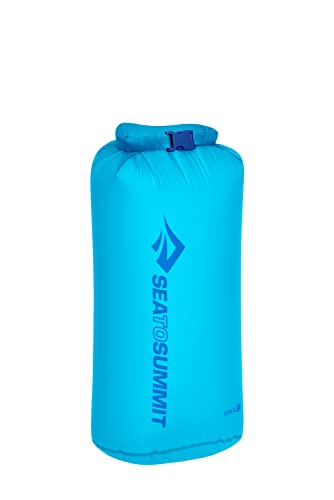 Sea to Summit Ultra-SIL Dry Bag, Waterproof, 13 Liter, Atoll BlueCheck Amazon offer
  Sea to Summit Ultra-SIL Dry Bag Set, Waterproof Stuff Sack (3L, 5L, 8L)Check Amazon offer
 Choose the compartment before choosing the liner
Decide what needs the liner’s protection. In a divided tackle backpack, lining only the upper personal-gear compartment can preserve convenient access to trays below. In an open-top pack, one larger liner may suit a mixed load. Do not expect a single liner to serve separate zippered compartments unless the bag’s internal layout allows it.
Trace the opening you use most often. A side-access backpack loses much of that convenience if the liner only opens at the top. Smaller dry bags can preserve selective access, while one large liner reduces the number of closures you manage. The better arrangement follows your retrieval routine.
Allow room for the closure
Measure the useful compartment with its normal load, then leave enough unfilled material for the liner to close as its instructions require. A liner stuffed to the rim is difficult to seal properly. Its advertised capacity should not be treated as permission to fill every available inch before rolling the top.
Use a shape that settles into the compartment without large folds pressed against tray corners. Pack soft items around rigid equipment where practical, and keep uncovered hooks, scissors and tool points away from the liner. The outer backpack protects against some abrasion, but objects inside can still damage a thin barrier.
Match construction to exposure
Sea to Summit describes its Ultra-Sil dry bag as an internal organizer made from lightweight 30D fabric. Its dry-bag guidance also states that roll-top dry bags are not intended for submersion. Those distinctions help define an internal liner’s job: protecting selected contents in ordinary wet conditions while supported by the outer pack.
If your critical requirement is surviving immersion, choose equipment with an explicit rating and operating instructions for that use. A roll-top closure, taped seams or waterproof fabric alone should not be turned into an unstated submersion promise. Electronics may still warrant their own appropriately rated pouch inside the larger system.
Keep wet equipment outside the dry boundary
A liner cannot protect spare clothing from a wet jacket placed beside it inside the same sealed space. Establish where used lures, damp gloves and a wet towel will travel. Keep those items separate until they can be dried, even when the liner still has spare room.
The same reasoning applies to a hydration reservoir. Position it in the intended sleeve where available, and consider what happens if its connection leaks. Do not put a water container among the items you most need to keep dry simply because the liner appears to offer convenient shared storage.
Test the routine before relying on it
Pack the liner with inexpensive, noncritical contents and practice closing, opening and replacing it. Check that zippers move freely and the divider remains supported. After each trip, inspect corners and closure folds, then dry the liner and backpack separately. A simple arrangement that you close consistently is more useful than a complicated system you leave open for convenience.
Questions about Fishing Backpack Liners: Protect the Main Compartment
Does a liner protect every pocket?
No. It protects only the contents inside its properly closed boundary. Exterior pockets and separate compartments remain outside that protection.
Is one large liner better than several dry bags?
Choose one liner for a shared compartment opened infrequently. Use separate bags when selective access or separating wet and dry equipment matters more.