models
KastKing Bait Boss 34L: Soft-Bait Storage Guide
The KastKing Bait Boss 34L gives soft-bait packets their own upper storage system alongside four 3600 tackle boxes. Those six PVC pockets distinguish it from the KarryAll: they matter if you regularly search through several packets, but offer less benefit when two bags of plastics cover the session.
As an Amazon Associate I earn from qualifying purchases. About affiliate links.
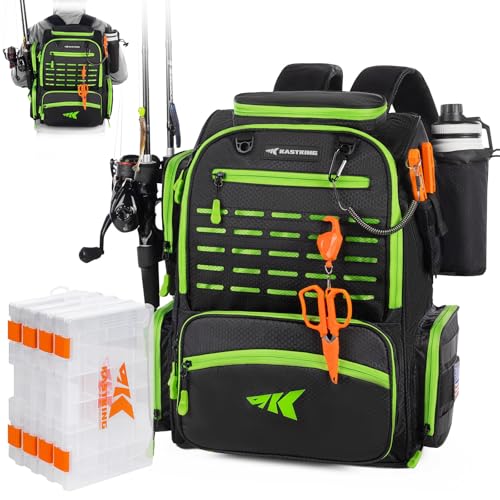 KastKing Bait Boss Fishing Backpack with Rod Holders, 4 Tackle BoxesCheck Amazon offer
  KastKing KarryAll Fishing Backpack with Rod Holder 4 Tackle Boxes, KhakiCheck Amazon offer
 Documented specifications for KastKing Bait Boss 34L
| Model | Capacity | Trays | Rod holders | Water protection | Offer |
|---|---|---|---|---|---|
| KastKing Bait Boss 34L | 34 L | 3600 · 4 trays | Not confirmed | Water-resistant PVC coating, rain cover and waterproof bottom are specified; the full pack has no verified submersion standard. | Check Amazon offer |
- Documented pack weight
- Not confirmed
- External dimensions
- Not confirmed
- Rain cover
- Documented
Four 3600 boxes included.
Six PVC soft-plastic pockets in the upper compartment; 20 total pockets/storage areas.
Marketing heading says waterproof; detailed construction is water resistant with a rain cover.
The distinguishing storage features
The manufacturer lists a 34-liter main storage compartment, four included 3600 boxes, and a folding padded partition. Six PVC pockets form the upper soft-plastic system within 20 total pockets or storage areas. A rain cover and a waterproof non-slip bottom are specified. The body description identifies water-resistant PVC protection, despite a broader waterproof marketing heading. This combination supports rain management, but the source does not establish a sealed, submersible pack. Rod holders are present; their exact count is not confirmed in the verified text.
Organize soft baits for retrieval
Use a simple system you can remember without looking at labels in perfect light. For example, assign groups by presentation: finesse worms, creature baits, trailers, and small paddletails. The aim is to avoid moving a handful of packets every time you change a lure. Keep products in their original packaging when their storage instructions call for it, and avoid casually mixing different soft-bait materials. Place the most-used group where you can see it first. If you rarely carry more than two packets, the extra organization may contribute little to your fishing routine and should carry less weight in the decision.
After each outing, note which bait groups you actually opened. A few trips of that simple record can show whether the upper system deserves a permanent place in your kit or mainly stores unnecessary reserve packets.
Keep the upper compartment usable
A storage system can become harder to use when every available pocket is filled. Pack a normal day first, including the nonfishing items that are easy to forget: food, a drink, extra clothing, and a place for rubbish. Open the upper area and see whether the items you need are visible. If snacks and loose clothing repeatedly fall across your bait selection, simplify that section or place personal items in a separate pouch. It is usually more useful to assign one home to each category than to maximize the number of small items that can be squeezed inside.
Evaluate the loaded pack, not the pocket count
Hooks, sinkers, and lead-head lures can make a moderate-size backpack unexpectedly heavy. Build one realistic load and walk with it before a long outing. A useful fit check includes bending to handle a fish, looking over each shoulder, and raising your arms as you would when casting. Nothing sharp should press through a pocket, and exterior gear should not swing freely. When choosing between this model and another pack, repeat the check with the same belongings. Comparing one empty bag to another fully loaded bag says little about which design actually suits your body or routine.
Rain-cover habits and who should choose it
Keep the cover accessible when the forecast looks unsettled; it is less useful buried beneath the gear you are trying to protect. A cover should be deployed before the fabric and openings become thoroughly wet, and essentials that cannot tolerate water deserve their own sealed storage. Dry the cover and pack separately after use. Give the Bait Boss preference if the six upper PVC pockets would replace a loose pile of bait packets you currently search through at each lure change. If you prioritize a quick two-box kit, or you need documented immersion protection, those requirements should drive you toward a different pack format instead.
Questions about KastKing Bait Boss 34L: Soft-Bait Storage Guide
What capacity does KastKing state?
The official Bait Boss page specifies 34 liters. Do not substitute the capacity of KarryAll or BaitSpace models.
How are soft plastics stored?
Six PVC pockets in the upper compartment form the dedicated soft-plastic system.
Does the rain cover make it submersible?
No submersion standard is established by the verified source. The cover adds weather protection to a water-resistant pack.