buying guides
Best Bank Fishing Backpacks for Moving Between Spots
The best bank fishing backpack is the smallest layout that carries the water, weather layer and working tackle your route requires without making repeated moves awkward. BlowBak Standard is the compact two-tray sling; KarryAll 40L is the conventional four-box backpack; Bait Boss 34L adds dedicated soft-plastic storage and a rain cover; BaitSpace 50L is the modular high-capacity option. Published capacity is a screening input, not proof that the loaded bag will fit your body or make frequent tackle changes easy.
As an Amazon Associate I earn from qualifying purchases. About affiliate links.
These are retained exact-model offers for BlowBak Standard, KarryAll 40L, Bait Boss 34L and BaitSpace 50L. Confirm the selected size, color and included-box package on Amazon; do not transfer Large BlowBak or optional BaitSpace module claims to these offers.
 KastKing BlowBak Tactical Sling Tackle Bag-Lightweight Fishing Backpack Storge Fishing Gear and Equipment,Gift for MenCheck Amazon offer
  KastKing KarryAll Fishing Backpack with Rod Holder 4 Tackle Boxes, KhakiCheck Amazon offer
 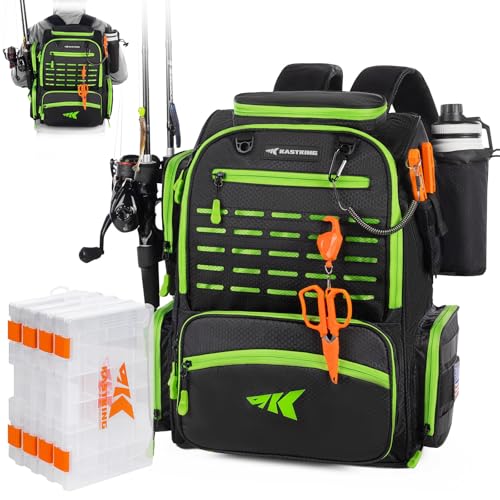 KastKing Bait Boss Fishing Backpack with Rod Holders, 4 Tackle BoxesCheck Amazon offer
 Side-by-side buying comparison
| Model | Capacity | Trays | Rod holders | Water protection | Offer |
|---|---|---|---|---|---|
| KastKing BlowBak Standard Sling | Not confirmed | 3600 · 2 trays | 1 | 1000D shell with interior water-repellent coating; no waterproof or submersion standard verified. | Check Amazon offer |
| KastKing KarryAll 40L | 40 L | 3600 · 4 trays | Not confirmed | Manufacturer describes water-resistant construction; no submersion standard found. | Check Amazon offer |
| KastKing Bait Boss 34L | 34 L | 3600 · 4 trays | Not confirmed | Water-resistant PVC coating, rain cover and waterproof bottom are specified; the full pack has no verified submersion standard. | Check Amazon offer |
| KastKing BaitSpace 50L | 50 L | 3600 · 4 trays | 2 | Water-resistant fabric and hydrophobic coating for rain and splashes; no submersion standard found. | Check Amazon offer |
The table uses exact manufacturer-documented model records. BlowBak is the Standard sling, not the Large option. Tray capacity, liters and pocket counts do not establish packed comfort, usable access or secure fit for your own equipment.
Start with the route and number of moves
A short walk to one open bank and a roaming shoreline session create different carry jobs. Count the walk from the vehicle, the likely relocations and the return with wet gear or rubbish. A bag that is easy to lift once may still be inconvenient when you shoulder it after every move.
For narrow vegetation, favor a compact outline and keep external attachments deliberate. On an open route, a larger two-strap pack can make sense when food, water and layers are necessary. Stop if the required load cannot be secured without items swinging, closures straining or rods repeatedly catching the route.
Choose the smallest documented tackle system
KastKing documents up to two 3600 trays for BlowBak Standard. KarryAll and Bait Boss each use four 3600 boxes, while BaitSpace fits up to four 3600 boxes and includes a removable soft-bait binder. The BaitSpace cooler and line-spooling modules are separate purchases. These are different working layouts, not a simple progression from worse to better.
Choose BlowBak Standard when two trays genuinely cover the session and front access matters. Choose KarryAll when a conventional four-box load and general cargo space fit the plan. Choose Bait Boss when its six soft-plastic pockets solve a real organization problem. Choose BaitSpace only when the removable binder or convertible main compartment justifies the larger 50-liter format.
Separate volume from the carried load
Liters describe nominal storage, not the weight you will carry. Build the load in groups: empty bag, trays and tackle, water, clothing, tools, food and externally attached rods or net. Use the Fishing Backpack Load Planner to see which group dominates before selecting a larger pack.
Do not fill every available tray slot by default. Dense terminal tackle can make a partly filled bag heavier than a larger bag carrying light clothing. If the required supplies fit but the load is uncomfortable, rearrange dense items close to your torso, reduce duplicate fishing tackle or choose a different harness. Do not remove route, weather or water essentials merely to hit an arbitrary weight.
Test access at each shore stop
List the three items you expect to reach most: for example an active tray, pliers and water. Pack everything else, place the bag on stable ground and retrieve those items in order. A large capacity is not useful if each change requires unloading layers or moving several boxes onto mud or a sloping bank.
BlowBak's sling layout can reduce the need to set the whole bag down, but a one-shoulder carry is not automatically better for a dense load. Full backpacks spread the carry across two straps but often work best as a set-down station. Choose the access pattern that fits how often you change tackle, not the one with the most pockets.
Make rod transport practical
Rod holders can be valuable on an open approach. Check where reels sit, whether the lower pocket supports the handles and how the upper straps limit movement. Make sure the load does not block your bottle or require disconnecting a rod for every box change.
Long upright rods can catch branches at overgrown spots. Protect hooks and break down travel setups when appropriate. Additional holders help only when they suit the route and do not encourage an awkward load.
Prepare for the ground
The bag often becomes a temporary station on gravel, grass or a sloping bank. A protected base can reduce exposure at the bottom but does not seal the rest of the pack. Keep sensitive items appropriately protected and avoid spots reached by waves or rising water.
Choose stable ground before opening several compartments. Contain discarded line and used packaging so moving quickly does not mean leaving waste behind. A small dedicated cleanup pocket can be more useful than another loose clip.
Keep the next move easy
Give opened bait packets, cutters and the active tray specific return positions. Before moving along the bank, close each zipper, contain hooks and tuck away loose tool-tether sections. These small returns should happen as you finish using the item, rather than leaving several open compartments to sort at once.
A slow repack often comes from too many tackle categories open together. Keep reserve boxes closed and designate one place for items still in use. When a pocket forces you to remove other equipment to put the active tray away, change that arrangement before adding bag capacity.
Run a parking-to-water check
Pack one ordinary session and walk a safe local loop with it before fishing. Shoulder and set down the pack several times, turn through a doorway with any rod case attached, and retrieve the three most-used items while the bag rests at your feet. Repeat with the return load you expect, including a stowed layer and contained waste.
Stop the comparison if the pack obstructs normal walking, pulls noticeably to one side or cannot close around required supplies. The right bank or shore pack is not the one with the largest stated capacity; it is the one that keeps the complete trip load controlled and the next move straightforward.
Questions about Best Bank Fishing Backpacks for Moving Between Spots
What size backpack is best for bank fishing?
Choose enough room for your day’s tackle, water and layers without awkward overflow. Distance and actual boxes are more useful than a universal liter target.
Are slings good for bank fishing?
Yes for a light kit. A heavier all-day load may suit two shoulder straps better.
Do bank anglers need rod holders?
They help when free hands improve the approach. Route clearance and the rod setup determine whether they are useful.
What should I look for in a shore fishing backpack?
Start with the walking route, required water and clothing, then choose the smallest tackle system that keeps your active tray and tools accessible. Test the full return load, not only the empty bag.
